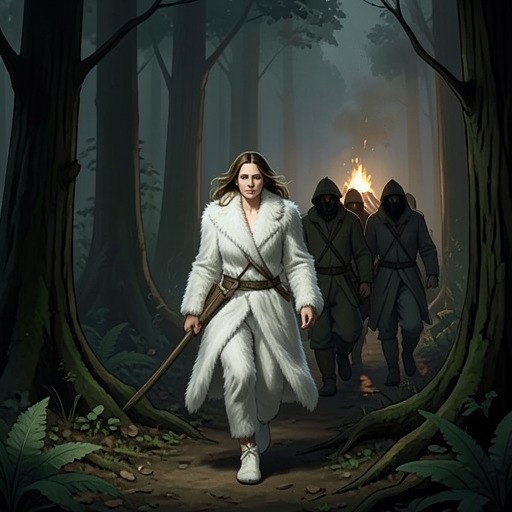
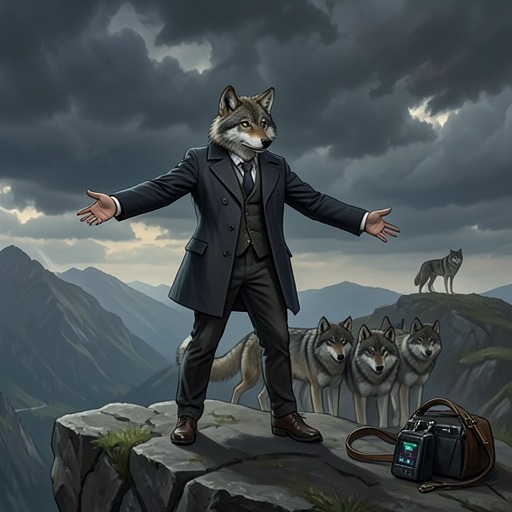
Ronald Lowell
Broken Rejected MateRonald Lowell is the Alpha of the Blue Blood Pack and one of the story’s central political antagonists. His authority first appears as disciplined guardianship: he commands immediate submission, oversees the pack’s finances and diplomacy, and warns against the danger posed by rebel wolves. That public image gradually fractures as his control over the pack is revealed to rest on murder, coercion, and an obsessive pursuit of greater power. By the end, Ronald is exposed, tried, and sentenced to death, while the leadership he seized passes into the uncertain hands of the younger generation.
Identity and Public Authority
Ronald is introduced through the physical and institutional force of the alpha role. When Alan Lowell returns late from the woods, Ronald’s low growl functions both as a warning and as a command for immediate submission. He questions where Alan has been running and invokes reports of rebel wolves, stressing that Alan could have been captured and killed. His concern is framed through the responsibilities of leadership: as alpha, he must manage pack members, expenditures, diplomatic problems, and every matter connected with the pack’s safety and well-being.
Yet Ronald’s authority is also personal and domestic. At a family meeting, he rebukes Alan for arriving late, while his wife, Alana Lowell, is described as a gentle but formidable alpha female and as a close companion to Alan’s late mother. Ronald’s position therefore places him at the center of both pack governance and Alan’s extended family. That combination makes his later betrayal especially destructive: he is not merely an external tyrant, but the uncle who has occupied a role of protection and family legitimacy.
When Ronald arrives at Sierra Langford’s home with three other important pack figures, his presence is deliberately intimidating. He is described as a comparatively short man with dark brown hair, an unreadable poker face, and a domineering presence. He sits without invitation and gestures for Doherty Langford to sit in his own house, establishing the hierarchy through simple physical acts. Doherty responds submissively by addressing him as Alpha Lowell. Ronald then states that he wants both Doherty and Sierra to join his pack, presenting recruitment as a simple request while the circumstances make it unmistakably coercive.
Hidden Crimes and the Logic of Power
Ronald’s public language of pack welfare eventually collides with the accusation that power, rather than responsibility, has always been his true motive. Alan confronts him with the claim that Ronald was dissatisfied with serving as his brother’s second in command, murdered his brother and his mate, killed the reigning alpha couple, and took the position for himself. Ronald does not immediately deny the accusation with outrage; instead, he asks how Alan learned the truth. His calm response confirms the seriousness of the revelation before he later attempts to dismiss the account as defamatory.
The revelation also reinterprets Ronald’s relationship with Alan. The uncle who once disciplined Alan as a dangerous but subordinate young wolf is implicated in the deaths that left Alan without his parents. Caroline eventually tells Alan directly that his uncle killed them. Ronald’s political rise is therefore inseparable from the destruction of the family whose authority he inherited. His rule is not simply a disputed succession; it is a succession built over the bodies of the people who stood before him.
Ronald’s stated justification is the betterment of the pack and the upliftment of his family. His actions expose that justification as rationalization. He seeks not only to retain office but to enlarge the strength available to himself and selected allies, converting the language of collective protection into a mechanism for private advancement. The contrast between his administrative persona and his concealed violence gives the character a distinctly divided structure: the responsible alpha mask remains useful precisely because it makes predation appear like governance.
The Plot Against Sierra Langford
Ronald’s most immediate scheme concerns Sierra Langford’s Dysomnian magic. Alan and the twins overhear that Ronald intends to kidnap Sierra, extract her magic, and use it to make himself and several other pack members stronger. The extraction will probably kill Sierra, and resistance is to be answered with lethal force. The plan turns Sierra’s unusual heritage from a feared identity into a resource Ronald wants to mine. Her body and power become, in his political calculus, material for strengthening the ruling faction.
Ronald monitors Sierra’s development closely. When Alan overhears Ronald asking for a progress report, another speaker reports that Sierra has unlocked most of her powers, becoming stronger, faster, and more capable than anyone previously seen. The same report acknowledges that she discovered how to cure Anthony Lowell. Ronald responds by calling Sierra a continuing thorn in his side and declares that Alan may have to be killed, just as Alan’s parents were killed. The statement links the present conspiracy to the earlier murders and shows that Ronald views both Sierra and Alan as obstacles to be removed rather than people bound to him by family or pack obligation.
The crisis becomes more dangerous after hunters ambush Sierra and inject her with yellow wolfsbane. Ronald tells Alan that the poison is dangerous and that Sierra will die without immediate help, offering the pack healer as the solution if Alan brings her back. Even this apparent offer of aid is inseparable from coercion: Ronald possesses information and access to treatment while continuing to pursue Sierra’s capture. The result is a cruel double bind in which the authority responsible for the threat presents itself as the only practical route to survival.
Conflict, Exposure, and Trial
Ronald’s conflict with Alan intensifies because Alan refuses to accept the vocabulary Ronald uses to defend himself. Ronald speaks of the pack’s improvement and his family’s advancement, but Alan identifies power as the consistent driving force behind his uncle’s conduct. This confrontation makes the political dispute explicit: Ronald treats strength as a justification for rule, while Alan treats the protection of vulnerable pack members as the measure of legitimate leadership.
The twins’ discovery of the kidnapping plan makes Ronald’s intentions impossible to dismiss as rumor. Their overheard conversation confirms that the plan is active and that Sierra’s life is expendable. The accumulated evidence then converges with the older accusation that Ronald murdered Alan’s parents. When Ronald is asked directly about that crime, he neither produces a credible denial nor expresses remorse. His refusal to engage with Alan’s pain demonstrates how thoroughly he has reduced family history to a problem of political management.
After Andrew Lowell dies and the pack faces the consequences of Ronald’s rule, a council of powerful alphas from across the country is formed to decide Ronald’s fate. A witch extracts a confession covering the murder of his alpha and mate as well as other crimes. Ronald surprisingly asks for a death sentence himself, suggesting that guilt has finally broken through the composure that protected him. The council sentences him to death at sunrise the following day. Alan and Sierra do not attend the execution, remaining instead at the Lowell family cottage, which serves as their safe haven while the pack’s future is unsettled.
Legacy and Narrative Significance
Ronald’s legacy is deliberately contradictory. His initial acceptance of Sierra and his role in overseeing her growth and control help spread the understanding that Dysomnias are not inherently a danger to werewolves. Sierra recognizes that he played a vital part in making the wider wolf population less afraid of Dysomnias, even while he later attempts to exploit and kill her. This does not redeem him; it demonstrates that harmful institutions and compromised leaders can produce limited forms of protection while pursuing destructive ends.
His downfall also creates the Blue Blood Pack’s leadership crisis. After Ronald’s death, the pack has no alpha, and its elders explain that a pack cannot survive indefinitely without a leader. Alana declines to govern temporarily, and Anthony Lowell is said to have no desire to become the next alpha, leaving Alan Lowell as the only remaining wolf with alpha blood who is willing to be considered. Ronald’s seizure of power thus ends by forcing the pack to confront succession openly rather than allowing authority to remain concentrated in one older figure.
Ronald’s influence reaches even into the younger pack’s future. Alan is eventually recognized as eligible for the alpha position because of his strength, courage, mercy, and fairness, qualities set against Ronald’s manipulation and brutality. Sierra’s relationship with Alan, their completed mating bond, and their decision to try for a child further suggest a new model of inheritance: not power extracted from others, but family and leadership built through mutual protection. Ronald’s story ends with the destruction of the authority he mistook for strength, while the people he sought to control begin constructing a different political and familial order.